


Thin client computing is a network-based approach to information processing. With Acucorp's enabling thin client technologies, your software can display on Windows front-end clients, access COBOL programs in practically any server operating environment, permit local or remote printing, and allow remote debugging from Windows.
Server-side Processing
Different from distributed processing environments where some application components are processed on the client and some on the server (and the application is engineered accordingly), thin client configurations perform all processing on the server and pass simple screen commands between the client and the server. Because server hardware is usually faster and because data access on the server is local, application performance often improves when processing is performed on the server.
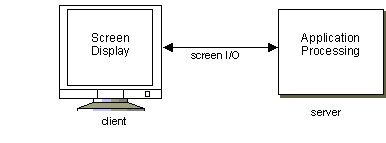
Server Processing Diagram
Application Architecture
In a thin client configuration, your application is comprised of two logical layers: a user interface (UI) layer on the display host (client) and a COBOL layer on the application host (server). The UI layer handles screen, mouse, and keyboard activity, and the COBOL layer performs application processing. Because no application components are required on the client (unless you want to use ActiveX controls), it is considered to be "thin."
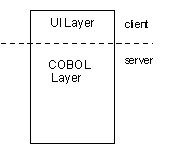
Application Logic
Split Runtime
Rather than forcing you to split your application into client and server components, the ACUCOBOL-GT runtime has been split so that your existing application can be displayed on the client. The runtime portion that is installed on the thin client is known as the ACUCOBOL-GT Thin Client. The Thin Client can be installed from your Acucorp product CD-ROM or downloaded from Acucorp's Web site. The full ACUCOBOL-GT runtime is installed on the server.
To function, the split runtime makes use of a "remote COBOL listener" on the server known as AcuLaunchTM. The role of the listener is to listen for requests from clients to launch the ACUCOBOL-GT runtime on the server. When a request is received, AcuLaunch starts a new runtime on the server, connects that runtime with the client process, and removes itself from the communication stream to wait for other requests from other enabled applications. Once initiated, the runtime on the server executes the COBOL application, and sends screen commands back to the client.
Together, the ACUCOBOL-GT Thin Client, the ACUCOBOL-GT runtime, and AcuLaunch are the enabling technologies that make up Acucorp's thin client solution.
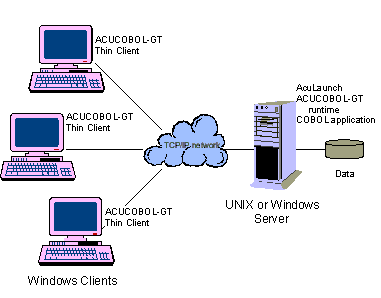
Acucorp's Thin Client Solution