The following section includes examples of how data dictionaries are formed. For more information, see section 6.2.1, "How the Data Dictionary Is Formed".
If your program has one file with the three records shown below, the underlined fields are included in the database table by default (this example assumes that ar-codes-key is named in a KEY IS phrase). Some fields do not appear in the table, but the data dictionary maps them to the "master" field names. The interface thus eliminates redundancies and gives you optimum performance.
01  ar-codes-record.
    03  ar-codes-key.
        05  ar-code-type     pic x.
        05  ar-code-num      pic 999.
These fields are included because they are the key.
01  ship-code-record.
    03  filler               pic x(4).
    03  ship-weight          pic s999v9.
    03  ship-instruct        pic x(15).
01  terms-code-record.
    03  filler               pic x(4).
    03  terms-rate-1         pic s9v999.
    03  terms-days-1         pic 9(3).
    03  terms-rate-2         pic s9v999.
    03  terms-descript       pic x(15).
These fields are included because they comprise the largest record.
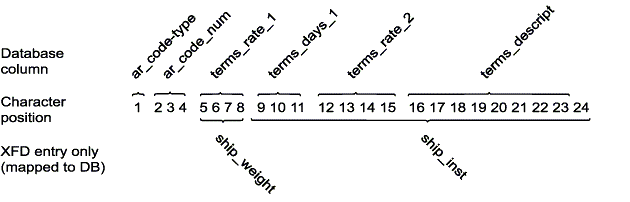
The diagram below shows how AcuODBC identifies database columns for some of the fields in the COBOL record, while other fields are mapped to those columns by the data dictionary; this means that all the fields are accessible to the COBOL program.