


AcuConnect allows you to distribute your application components to best use your enterprise resources. You can perform most of your processing on the client (in a "fat" client arrangement), most on the server (in a "thin" client arrangement), or divide the processing equally. The ability to choose between these options or select anything in between makes the AcuConnect client a "smart" client.
The following diagram depicts how applications can be distributed anywhere you want with AcuConnect.
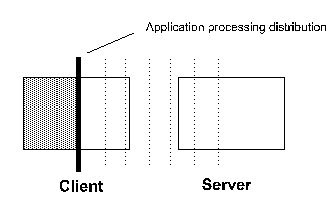
Like any paradigm, there are advantages and disadvantages to the thin and fat client approaches. Deciding where to distribute your processing tasks requires extensive knowledge of the network. Your decision should be based on several issues, including:
When to Use a Thin Client
For performance reasons, the "thin" client approach is ideal for data-intensive applications such as reporting. Data-intensive applications typically have a small number of screen I/Os and ACCEPTs, so they can easily be executed on the server to reduce network traffic. The client in this case is "thin", because the server performs the bulk of the application processing.
When to Use a Fat Client
The "fat" client approach is more suitable for screen intensive applications with interactive data entry. Such applications would suffer performance degradation if processing were performed on a server and passed across the network. By keeping interactive applications on the client, network traffic can be kept at a minimum.
When to Use a Smart Client
In reality, most applications have a combination of screen and data I/O. To maximize performance, you can divide your application into a client component and a server component, splitting the processing responsibilities between the client and the server where you see fit. The "smart" client approach is the foundation of AcuConnect. AcuConnect lets programmers or systems analysts design enterprise applications so that they utilize the least amount of network resources while at the same time reducing response time.